

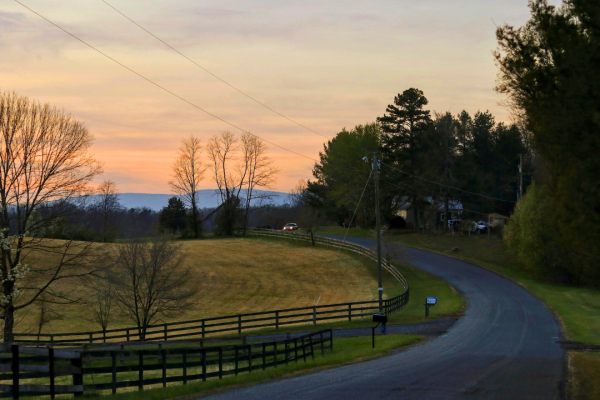
The Country Road Toward Christlikeness: Discipling Men the Rural Way
A country road is a patient tutor, the kind that never hurries and never apologizes for its pace. It bends and curves according to the lay of the land, not the restlessness of the traveler. It rises slowly, dips without warning, and keeps its own counsel about how far and how fast the journey should go.
You can’t argue it into being straight. You can’t coax it into taking shortcuts because there are no shortcuts. You simply take it as it is – walking or driving at the speed it grants you. And somewhere in that unhurried rhythm, your own pulse begins to settle into something steadier. Discipleship, especially among rural folk, is very much a country road.
"Discipleship, especially among rural folk,
is very much a country road."
Follow that road long enough and you begin to notice the kind of people who live along it – men and women shaped by the same rugged terrain, whose lives move to the same unrushed cadence. Their way of being emerges from the land itself.
Shaped by seasons instead of schedules
Rural people grow the way cornfields do – quietly, gradually, without haste. The men, in particular, move with that same unspoken tempo, shaped by seasons instead of schedules. They trust what their hands can hold more than what their minds can theorize. Their relationships are formed shoulder to shoulder rather than face to face.
Study guides and tidy circles of chairs hold little appeal. They are men of calloused hands and early mornings, who speak most honestly when their bodies are in motion. They gain wisdom from listening to stories told at the end of a long day, more than by reading words on a page.
Yet many rural churches still rely on discipleship models built around reading assignments, discussion circles, and classroom‑style learning – approaches that often fail to connect with men who learn best by doing. Rural men aren’t uninterested in spiritual growth. They simply grow differently. When a church recognizes this and shapes discipleship around the rhythms of rural life, something powerful happens: men open up, faith deepens, and community strengthens.
"Rural men aren’t uninterested in spiritual growth.
They simply grow differently."
I’ve watched these men long enough to know that work is their first language. In rural culture, work is not just a task – it’s a kind of liturgy. Fixing fences, cutting firewood, repairing a widow’s porch, or helping a neighbor move hay bales creates natural space for conversation and trust. Put two of them in a truck headed down a dirt road toward a neighbor’s broken porch, and you’ll hear more truth in that twenty‑minute ride than in a month of formal meetings.
A hammer in hand becomes its own repeated ritual. Splitting wood or mending a fence provides space for conversations that would never survive under fluorescent lights. Faith, for them, is not an idea to be discussed but a life to be lived, and they learn it best by watching another man live it.
Likewise, recreation has its own way of inclining the ears and untying the tongue. A fishing line cast into still water, the crunch of leaves under boots during hunting season, the glow of a campfire on a summer night – these are the sanctuaries where rural men feel most at ease. They don’t need an agenda. They need presence.
“They don’t need an agenda.
They need presence.”
They need the kind of laughter that comes from shared stories and the kind of silence that doesn’t demand anything. In those moments, when the guard drops and the heart settles, a simple prayer or a quiet biblical reflection can slip in naturally, like an old friend pulling up a chair on the front porch.
And then there is mentoring, though most rural men would never call it that. It happens in the ordinary ways: a younger man riding along in the tractor cab, an older man teaching him how to sharpen a chainsaw blade, two generations walking a field together and talking about weather, work, and the weight of being responsible for something.
Rural men have always learned by apprenticeship. They absorb character the way barns absorb the smell of hay – slowly, over time, through proximity. A seasoned man doesn’t need a curriculum to disciple someone. He needs to invite someone into his life, into the real, unvarnished places where faith is tested and proven.
“They absorb character the way barns absorb the smell of hay –slowly, over time, through proximity.”
Jesus set the example
It’s worth remembering that Jesus discipled men in much the same way. His closest followers were fishermen, tradesmen, men accustomed to weather and work. There is no record of Him gathering them for Bible study on Tuesday mornings or prayer meetings on Wednesday nights.
Instead, He walked with them along dusty roads, sat with them in fishing boats, worked beside them as they hauled nets from the sea, ate countless meals with them, and probably even sipped fine wine with them at a wedding reception. His teaching was woven into the fabric of their days – a question asked while traveling, a parable told while resting under a tree, a rebuke or encouragement offered in the mundane moments of real life. He discipled rural men by living among them, not by scheduling them.
"He discipled rural men by living among them,
not by scheduling them."
When a church begins to honor these patterns instead of trying to replace them, something beautiful happens. Discipleship stops feeling like a program and starts feeling like friendship. Men who would never speak up in a classroom begin to share their burdens in the cab of a pickup. Those who feel uncomfortable with a Bible commentary discover that Scripture comes alive when read at dawn before a hunt or reflected on while repairing a neighbor’s roof. The gospel becomes less of a lecture and more of a lived story.
In time, the fruit shows. Marriages become healthy. Fathers become more attentive. Young men find direction. Older men rediscover purpose. And they eventually become a band of brothers rather than a collection of attendees.
And all of it grows quietly, like a field in spring, tended not by regimented programs but by the patient, interpersonal work of forming souls in places where life is actually lived. It is not efficient, and it is not meant to be. Nothing alive grows by shortcuts.
Discipleship in a rural church is, in the end, the same country road we started on. It winds through wheatfields and woodlots, past barns and back porches, through seasons of planting and seasons of waiting. It asks for patience. It asks for presence. It asks for the kind of faith that is content to move at the speed of real life.
"Discipleship stops feeling like a program
and starts feeling like friendship."
On that road, men learn to follow Jesus the way travelers learn the landscape – slowly, by noticing what they once overlooked, by walking the same stretch often enough that the bends feel familiar and the ruts no longer catch them off guard. Christlikeness isn’t a finish line to be crossed but a manner of going, a long obedience shaped by life’s twists and turns and the companions who walk beside us.
And if you stay on that road long enough, you begin to see what Jesus saw in His fishermen and farmers: that the journey itself is the shaping. The road does its quiet work. It forms men who are steady, rooted, and real. Men who understand that the only way to travel a country road – or to become like Christ – is to keep putting one foot in front of the other in the right direction.
Jason McConnell is the director of Rural Church Institute at the Billy Graham Center at Wheaton College